
Día de Muertos: Why Death in Mexico Comes with Flowers, Sugar, and a Very Elegant Catrina

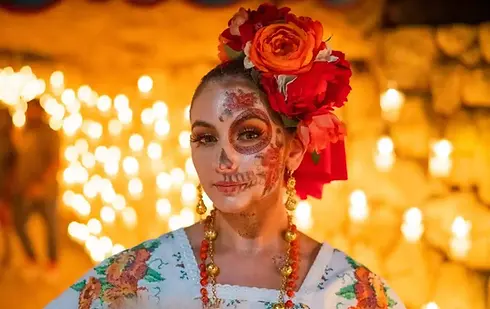
If someone in Mexico hands you a brightly decorated sugar skull in late October and your own name is written in icing across its forehead, there is no reason to panic. Nobody is sending you a sinister message. More likely, you have just been included in a very Mexican joke — one that somehow manages to be sweet, funny and perfectly serious about the fact that no matter how important we may feel today, the ending is eventually the same for everyone. In fact, a little calaverita may be one of the best places to begin understanding Día de Muertos, because it captures the strange beauty of the entire tradition: death here does not always stay behind a closed door. It can be talked about, drawn, molded out of sugar, dressed in extravagant clothing and laughed at, while that very same evening a family may carefully place a photograph of someone they deeply miss on an altar in their home.
To understand how humor and grief became such comfortable neighbors, you have to travel much farther back than colonial Mexico. Long before the Spanish arrived, Mesoamerican peoples already had complex ideas about death, ancestors and what happened after physical life ended, and those ideas were very different from the familiar European model of a moral heaven and hell. Among the Nahua peoples, including the Mexica, whom we usually call the Aztecs, a person's destination after death depended largely on the circumstances of death rather than simply on whether that person had lived a morally “good” or “bad” life. Some deaths were associated with the Sun, others with Tlalocan, the realm connected to the rain god Tláloc, while many of those who died ordinary deaths were believed to begin a journey toward Mictlán, the land of the dead.
And Mictlán was not exactly a quick transfer from one world to another. According to Nahua traditions recorded in historical sources, the dead had to pass through nine levels and the journey could take four years. There were obstacles to overcome, and one creature associated with helping a soul along the way was the xoloitzcuintle, Mexico's ancient hairless dog. The xolo may look like an unusually stylish national breed today, but its older résumé was much more serious: dogs and representations of dogs appear in Mesoamerican funerary contexts because of their association with guiding the dead. Once you know that, an important part of the older worldview begins to make sense. Death was not simply disappearance; it could be understood as a journey, and a traveler might need water, food, objects and help. Centuries later, when we see water, food and personal belongings on a Día de Muertos ofrenda, the cultural resonance is difficult to miss, even though it would be historically misleading to claim that every element of the modern altar descends directly from a specific Aztec ritual.
It is equally misleading to repeat the popular tourist version that today's Día de Muertos is simply the ancient Aztec festival surviving unchanged on November 1 and 2. Pre-Hispanic peoples certainly had ceremonies, offerings and calendar observances related to the dead, but the dates we now associate with Día de Muertos came with Catholic Christianity and the observances of All Saints' Day and All Souls' Day. What happened after the Spanish conquest was much more interesting than one tradition simply replacing another. Christianity arrived in societies where people already had sophisticated ways of thinking about death and ancestors, where offerings to the dead were familiar and where the relationship between the living and the deceased was imagined differently from the European Christian world. Over centuries, those traditions interacted, transformed one another and gradually produced something that cannot honestly be called entirely Indigenous or entirely Catholic. It became Mexican.
Something very similar happened with the sugar skull. Skull imagery had an enormous presence in pre-Hispanic Mesoamerica; the famous tzompantli, structures on which real human skulls were displayed in ritual contexts, are perhaps the most dramatic example. But the Mexica were not making sugar calaveritas. The confectionery tradition of alfeñique came into New Spain through the European colonial world, and in Mexico the craft of shaping sugar paste encountered a culture in which the skull already carried powerful visual and symbolic meaning. The result was a wonderfully improbable object: European sugar transformed into a brightly decorated Mexican skull. The most charming part is that the name written across the forehead does not have to belong to someone who has died. A calaverita can be given to a perfectly healthy friend, relative or coworker with their own name on it, turning the candy into a playful memento mori: here is your tiny sweet death, now eat it and get back to living.
That same ability to make death part of everyday language rather than an unspeakable subject also appears in the tradition of calaveritas literarias, playful satirical verses in which Death comes after living people — politicians, friends, public figures or whoever happens to be the target of the joke. They can be clever, irreverent and surprisingly sharp, and they reveal something important about Mexican humor around mortality. Laughing at death does not mean grief disappears. It simply means death does not get exclusive control over how the conversation sounds.
No figure has come to represent that conversation more famously than La Catrina, the spectacularly elegant female skeleton who now seems so inseparable from Día de Muertos that visitors often assume she must be an ancient goddess. She is not. La Catrina is barely more than a century old, and her story began as social satire. In the early twentieth century, Mexican printmaker José Guadalupe Posada created the image known as La Calavera Garbancera, essentially a female skull wearing an exaggerated European-style hat. She did not yet have the elaborate gown or even the full body we associate with Catrina today. Posada was mocking social pretension, particularly people who wanted to present themselves as European elites while distancing themselves from their own Indigenous or Mexican roots. You could wear the most sophisticated imported hat in the city and pretend to belong to another social world, but underneath it all there was still the same skull.
Decades later, Diego Rivera gave the figure the form most people now recognize. In his 1947 mural Dream of a Sunday Afternoon in Alameda Central, he gave her a full body, dressed her as an elegant lady and placed her beside Posada and a child version of Rivera himself. The satirical skeleton gradually became La Catrina, one of Mexico's most recognizable cultural icons. Knowing where she came from makes her much more interesting than a generic “lady of the dead.” She does not merely remind us that everyone dies; she also quietly makes fun of how much energy the living spend proving their wealth, status and importance. Under the expensive clothes, the anatomy is remarkably democratic.
Once you know these stories, the modern ofrenda also looks different. From the outside it can seem like a beautiful arrangement of candles, flowers and photographs, but a family altar is much closer to a biography told through objects. There are recognizable elements — candles, water, pan de muerto, papel picado, cempasúchil, sometimes copal, religious images and sugar skulls — but the most touching part begins when the standard symbols stop. You might find someone's favorite Coca-Cola, coffee, mole, tequila, cigarettes, candy, a musical instrument, a toy or some ordinary object that would mean nothing to a stranger but instantly unlock a family story. A meaningful ofrenda does not primarily tell you how someone died. It tells you how that person lived.
Cempasúchil, the intensely orange marigold that seems to change the color of Mexico every autumn, has become one of the most visible parts of that language of remembrance. Its petals are used on altars and sometimes arranged into pathways, while its vivid color and strong scent are traditionally associated with helping guide the dead toward the ofrenda. Candles provide light, water welcomes the traveler, food waits on the table, and together these elements create a remarkable reversal of the instinct to make death invisible. For a few days, memory is deliberately brought into the center of the home.

Perhaps that is why Día de Muertos feels so different once you stop looking at it as a photogenic festival and begin paying attention to what is actually happening. Modern Mexico has certainly added monumental public altars, parades, concerts, elaborate Catrina makeup, festivals and images made for the age of Instagram, and none of that automatically makes the tradition less authentic. Living cultures are allowed to change. Yet underneath all that spectacle, there is still an extraordinarily simple scene: a family takes out the photograph of someone who is gone, prepares something that person loved, remembers their habits, tells the younger generation their stories, sometimes laughs and sometimes cries, and for a few days gives the dead a visible place among the living again.
That, more than anything, may be what makes Día de Muertos so fascinating. It is not the story of a society that somehow learned not to fear death, and it is not an untouched Aztec ritual that survived exactly as it was. It is the result of a centuries-long conversation between cultures, in which ancient Mesoamerican ideas of death as transition and journey encountered Catholic remembrance of the dead, European sugar work encountered an old symbolic fascination with skulls, Posada's political caricature became the elegant Catrina, and family memory grew into one of Mexico's most recognizable traditions. Death here can appear as a nine-level journey to Mictlán, as a xolo waiting to guide a traveler, as a skeleton wearing an expensive hat, or as a tiny decorated sugar skull carrying your own name. Yet behind all those images is a surprisingly simple thought: a person may die, but as long as someone still remembers what they loved, tells their stories and speaks their name, death does not get to erase them completely.



Comments