
Bringing Your Attention Back to Yourself: Why Yoga, Breath, and Sometimes a Change of Scenery Still Matter


We know how many steps we took today. How long we slept. Our watches remind us to stand up, drink water, breathe, and go to bed. We can find advice on how to eat, exercise, work, parent, build relationships, recover, and even relax.
There is more information than ever.
And sometimes, less clarity.
You can know everything about healthy living and still miss the fact that you’re exhausted. You can follow a perfect workout routine and gradually lose touch with how your body actually feels. You can spend years making responsible decisions based on what you “should” do and eventually realize that one very simple question has become surprisingly difficult:
What do I actually want?
That is where Be Infinite begins for me.
Not with becoming a better version of yourself. With learning to hear yourself again.
We have become very good at reacting
Your phone vibrates. You look.
A message arrives. You answer.
A task appears. You handle it.
Someone expects something. You respond.
You’re tired. You reach for coffee.
Your mind feels overloaded. You open another video.
You feel uneasy. You search for more information.
Slowly, the space between what happens to us and how we respond becomes smaller.
Nothing has to be dramatically wrong.
You may not be unhappy. You may not be in crisis.
You may simply be spending a lot of your life on autopilot.
And one of the most valuable things we can learn today may be how to recreate that small space between stimulus and response.
Strip away the Sanskrit and the spiritual imagery, and this is one of the ideas at the heart of classical yoga.
Yoga was never just about the body

Today, the word yoga often brings up a familiar image: a mat, leggings, downward dog, impressive balances, flexibility.
All of that can be part of yoga.
But asana - the physical posture - is only one part of a much larger system.
In the classical eight-limbed path described in Patanjali’s Yoga Sutras, asana sits alongside yama and niyama - principles that shape how we relate to ourselves and others; pranayama - working with the breath; pratyahara - learning not to be automatically pulled toward every external stimulus; dharana - concentration; and dhyana - sustained meditative awareness.
In other words, yoga was never designed simply to help us touch our forehead to our knee.
The body was a tool.
The breath was a tool.
Attention was a tool.
Even learning not to react automatically to everything we see, hear, and feel was a tool.
For what?
To make the internal noise a little quieter.
So we can hear ourselves a little more clearly.
None of this requires leaving modern life behind
I don’t believe becoming more aware requires moving to an ashram, giving up your phone, living in the forest, or deciding that modern life is somehow wrong.
This is the life we live.
We have jobs, businesses, children, flights, deadlines, cities, social media, and technology.
All of that can stay.
The more interesting question is who is using whom.
Can we use our phone without giving it our attention every three minutes?
Can we work hard and still notice the moment our resources are depleted?
Can we listen to someone else’s advice and still ask whether it actually makes sense for us?
Can we feel an emotion without automatically turning it into an action?
This is where an ancient philosophy becomes surprisingly contemporary.
Sometimes the body knows before the mind does
We often treat the body as something we need to manage.
Train it.
Stretch it.
Change it.
Fix it.
Push it.
But the body is constantly giving us information.
Tight shoulders.
A clenched jaw.
Shallow breathing.
Heaviness.
Fatigue that doesn’t disappear after sleep.
Or the opposite: an unexpected sense of ease around a person, in a place, or after making a particular decision.
That doesn’t mean every bodily sensation is absolute truth. And it certainly doesn’t mean physical sensations replace medicine.
But the body is one source of information about our state.
That is what interests me most about asana practice.
Not whether someone can eventually stand on their head.
But how quickly the mat reveals patterns that exist far beyond it.
Where do you keep pushing long after something stops feeling right?
Where do you compete even when nobody else is competing with you?
Where do you hold your breath?
Where do you automatically think, “I can’t”?
Where do you ignore discomfort?
And where do you hesitate even though you are perfectly capable of taking the next step?
Yoga can become a small laboratory for how we live.
Breath is the tool we never have to pack
You can skip a workout.
Forget your mat.
Go several days without meditating.
But you will keep breathing.
That makes breath one of the most accessible tools for regulating our state.
In yoga, working intentionally with the breath is called pranayama.
There are many techniques, ranging from extremely simple to practices that require proper guidance and experience.
But the basic idea doesn’t require Sanskrit.
Our breathing changes with our state.
Fear has a breath.
Relaxation has another.
Crying has another.
Sleep has another.
And the relationship can work in the other direction as well: changing how we breathe can influence how we feel.
Not magically.
Physiologically.
That is why breath is used in yoga, meditation, relaxation practices, stress regulation, and birth preparation.
It is one of the rare tools that costs nothing, requires no app, and travels everywhere with us.
We simply have to remember how to use it.
Sometimes growth means doing less
We usually associate growth with addition.
Another course.
Another certification.
Another skill.
Another goal.
Another task.
But sometimes the next meaningful step requires adding nothing at all.
Sleep.
Rest.
Silence.
Turning off the phone.
Moving for an hour without trying to burn calories.
Lying still after practice.
Listening to music.
Swimming.
Going to a spa.
Having a conversation that has nothing to do with work.
And yes, drinking a glass of champagne by a pool is entirely compatible with an intentional life.
Awareness doesn’t have to look serious.
Sometimes you really do just need a good day.
But there is a difference between a break that leaves you needing another vacation and a break that actually restores your resources.
That is why I love the idea of wellness days.
Not another schedule packed with twenty “healthy” activities.
The opposite.
Gentle movement.
Good food.
Water or spa.
A beautiful environment.
Conversation.
A few hours when nobody needs anything from you.
Sometimes the thought you have been trying to solve for a week becomes obvious after a day like that.
Not because a spa gives you answers.
Because for once, your brain has enough quiet to hear them.
Sometimes we need to change more than the activity
Sometimes we need to change the environment.
This is where travel becomes another powerful tool.
We often treat vacations as collections of experiences.
See everything.
Photograph everything.
Visit everything.
Try everything.
Check every box.
And sometimes we return home needing another vacation.
Travel can work differently.
When we physically leave our usual environment, some of our automatic patterns disappear with it.
No familiar commute.
No usual grocery store.
No desk.
No environment constantly reminding us who we are supposed to be today.
For a few days, there is enough distance to look at our lives from a slightly different angle.
This is why I am drawn to slow travel and travel retreats.
Not a retreat where every hour from sunrise to bedtime is scheduled for personal transformation.
And not a sightseeing marathon where seven days have to contain twenty destinations.
Something in between.
A place where experience alternates with the space to actually absorb it.
One day, an ancient city.
Another day, the sea.
Yoga in the morning.
Exploration during the day.
Sometimes a practice.
Sometimes a spa.
Sometimes three completely free hours.
Because it is often in those empty spaces that an experience becomes something more than another photograph on your phone.
Why Mexico works so well
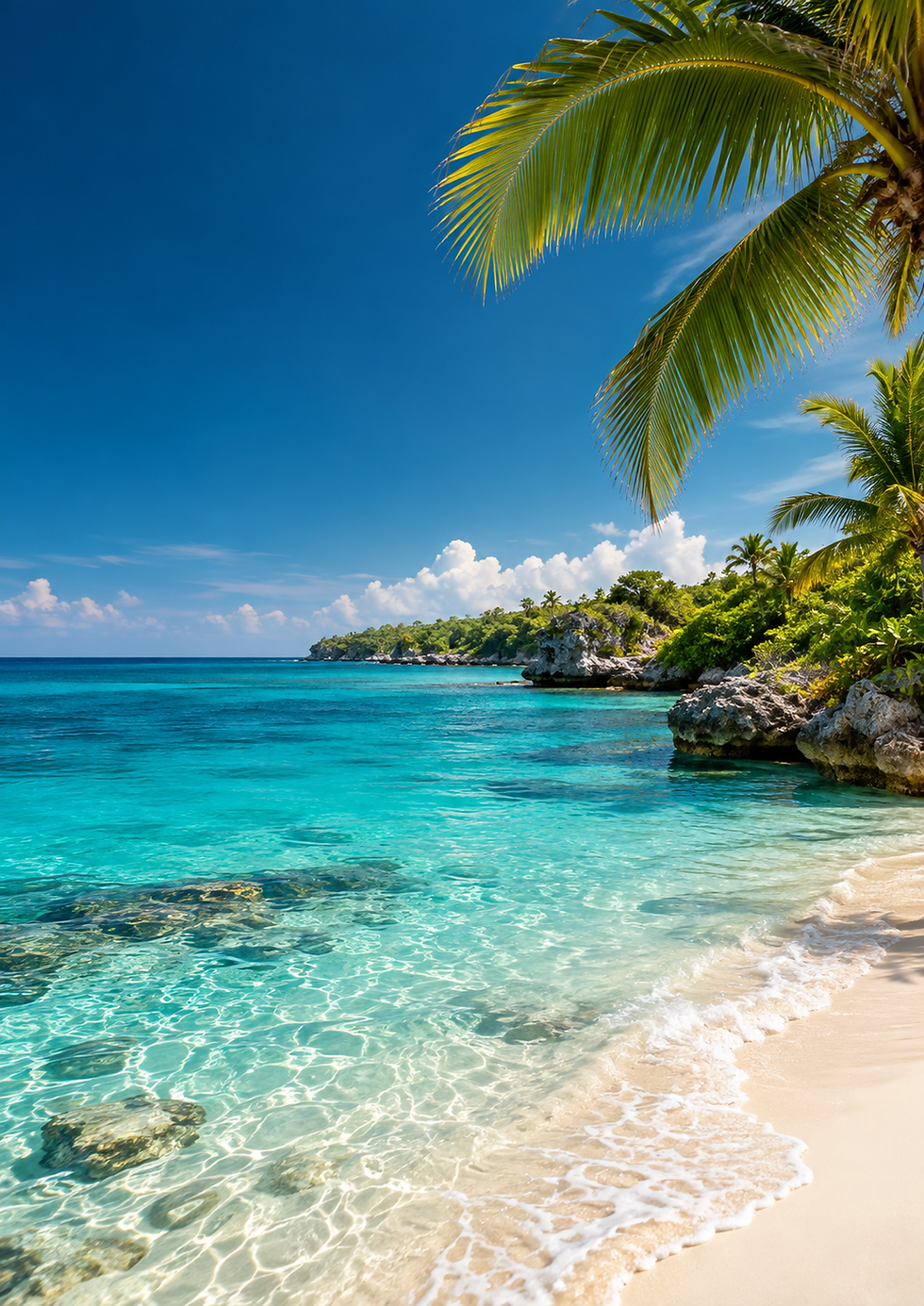
Mexico is almost made for this kind of travel.
The Caribbean.
The jungle.
Cenotes.
Contemporary cities.
Small towns.
Ancient Maya sites and an extraordinary cultural history.
Spa and wellness spaces.
Food.
Music.
And a completely different relationship with time.
That is why our Be Global journeys bring the country itself together with the philosophy behind Be Infinite.
You can explore ancient Maya cities, swim in cenotes, spend a day by the Caribbean, laugh over a long breakfast, meet interesting people, and experience Mexico.
But there is also room for yoga, breath, recovery, good sleep, free time, and the pauses that allow a journey to actually happen to you.
Not so that you come home a “new person.”
I’m not sure we constantly need to become new people.
I would rather come home a little more myself.
With new memories.
More energy.
A different question.
Or perhaps an answer that had been there all along.
Bringing your attention back to yourself
That is the philosophy behind Be Infinite.
Not escaping modern life.
Not rejecting what the world has built.
Not searching for another system that tells us the right way to live.
Simply keeping the ability to stop reacting for a moment and ask:
How do I actually feel?
What is happening in my body?
What is draining me?
What restores me?
What am I doing because I genuinely want to?
And what has simply become a habit?
Do I need movement right now — or rest?
People — or quiet?
To stay — or to go?
To continue — or to change direction?
Yoga cannot answer those questions for us.
Neither can meditation.
Breath cannot.
Travel cannot.
And that is exactly the point.
Their job is different.
They can create enough space for us to hear our own answer again.
Continue with Be Infinite
Yoga, breath and restorative practices, birth preparation, workshops, and wellness days are different ways of bringing attention back to yourself and spending a little less of life on autopilot.
And sometimes the reset you need involves changing not only your state, but your coordinates.
That is where Be Global begins.

Our Mexico journeys and travel retreats combine what makes travel worth crossing the world for new places, ancient culture, the Caribbean, nature, and interesting people while leaving enough space to actually experience it.
Explore Be Global journeys →


Comments